
If you are trying to make it in the indie comic market, creating a great comic book is only half the battle. You can have incredible artwork, a fire character, and a story that could compete with anything Marvel or DC is publishing, but none of that matters if nobody knows your comic exists.
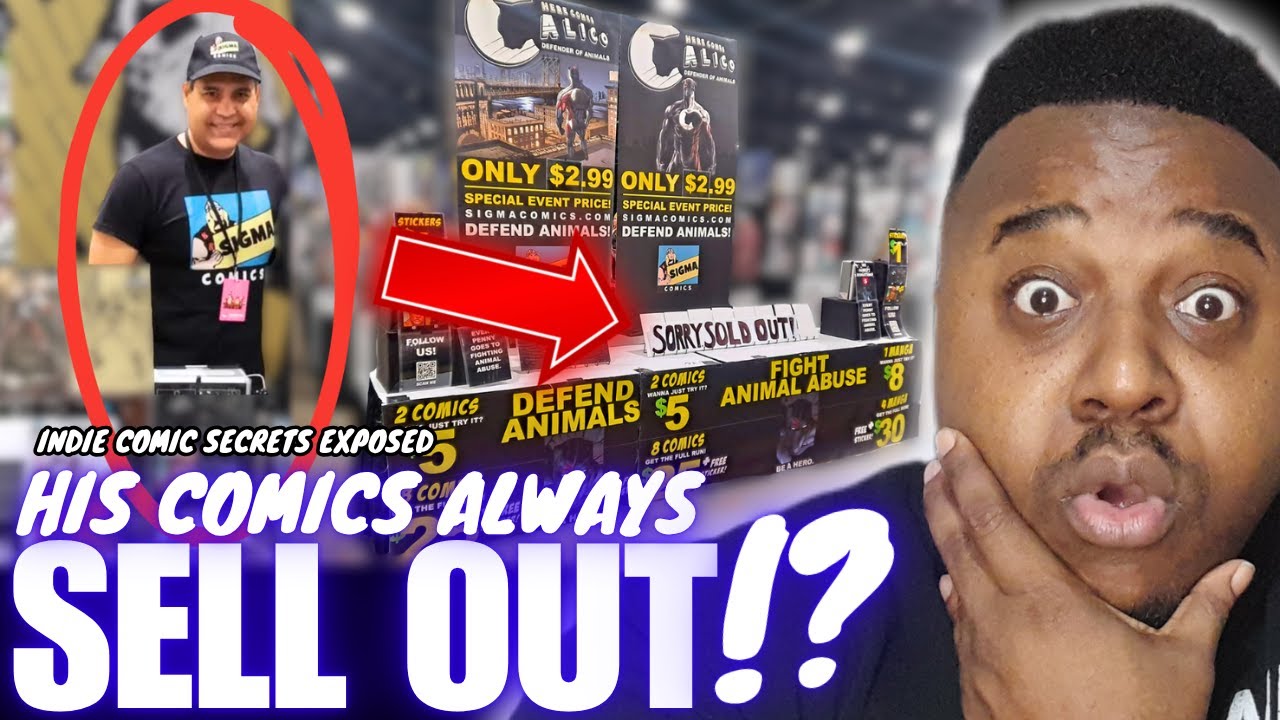
That was one of the biggest lessons I took away from my conversation with Double H of Sigma Comics, creator of Here Comes Calico. I have watched this brother promote his books for a while, and one thing I constantly noticed was that his comics kept selling out at conventions. I needed to know what he was doing differently.
What I discovered is that there really isn’t one magical trick to selling indie comics. The real secret is creating multiple ways for people to discover, buy, and become fans of your work. Conventions, direct sales, email marketing, Kickstarter, comic shops, local businesses, creative advertising, and strong branding all work together.
I call this strategy the octopus of success. Let me explain what I mean and why I believe more independent comic creators need to start thinking this way.
Stop Depending on One Way to Sell Your Indie Comic
One of the biggest mistakes an independent comic creator can make is building the entire business around one platform. I see people create a comic, launch it on Kickstarter, promote it on YouTube or social media, and then wait for the audience to show up.
That might work for a while, but what happens when Kickstarter slows down? What happens when YouTube stops recommending your videos? What happens when the social-media algorithm decides it doesn’t want to show your posts anymore? If your whole business depends on one source, suddenly your entire operation is in trouble.
That is where my octopus of success idea comes in. Your business needs multiple arms working at the same time: conventions, your own website, an email list, crowdfunding, comic shops, local businesses, social media, and direct customer sales.
If one arm gets chopped off, the other arms are still working. That’s how you build an actual indie comic business instead of hoping one website or algorithm keeps you alive.
Comic Conventions Can Be a Powerful Indie Comic Marketing Tool
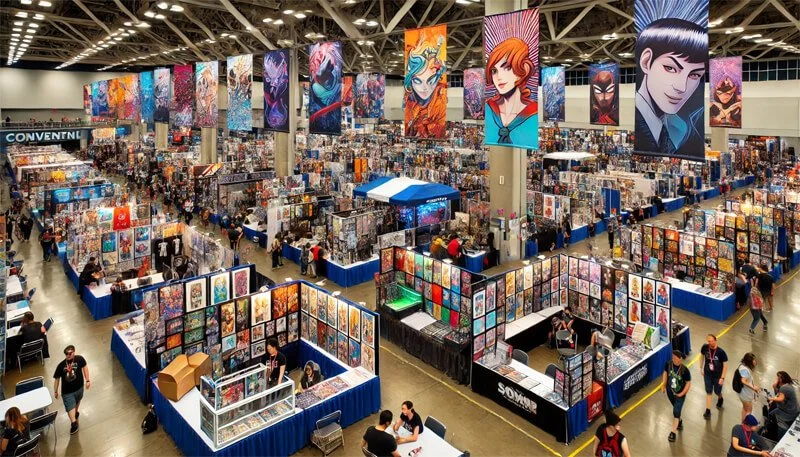
One of the most important things I learned from this conversation was the power of comic conventions. Sigma Comics has made conventions a major part of its strategy because there is something a website will never completely replace: you standing face-to-face with the customer.
Think about what happens when you simply put your independent comic inside a comic shop. Your book could be sitting next to hundreds of Marvel, DC, Image, Dark Horse, and other indie titles. Who is going to stop that customer and explain why your character matters? Who is going to tell them what inspired the story or why they need to give Issue #1 a chance?
Nobody can sell your creation better than you can.
At a convention, you can explain your character, show customers the artwork, tell them what makes the story different, answer questions, and watch their reaction in real time. You also start learning what actually gets somebody to stop at your booth and what gets them to pull out their wallet.
That kind of information is extremely valuable because you’re no longer guessing what your audience wants. You’re standing right in front of them.
Indie Comic Creators Have to Become Salespeople
I know some creative people don’t like the word salesman, but if you want your comic book to become a serious business, you have to learn how to sell.
Think about Stan Lee. That man knew how to sell excitement. Todd McFarlane understands business and promotion. These guys did not simply create something and sit quietly hoping somebody discovered it.
You have to make people excited about what you created.
If somebody walks up to your booth and you barely have enough energy to explain your own comic, why should that person get excited about buying it? You spent months or maybe years creating this character. Tell me why I need to read it. Tell me why your world is different. Tell me why this story is worth my money.
That doesn’t mean being fake or screaming at everybody walking past you. It means believing in your product enough to communicate its value.
Your Price Can Get New Readers Through the Door
Pricing was another strategy from the Sigma Comics conversation that caught my attention. At conventions, the company has offered individual comics at extremely affordable introductory prices.
Think about the psychology behind that. Somebody may have already spent $70 or more just entering a major convention. Then they bought food, merchandise, action figures, or other comics. Suddenly they walk past an independent comic booth and see a book for only a few dollars.
Even if they have never heard of that character before, the risk is low enough for them to say, “Shoot, why not?”
That is especially important when you’re building a new IP. You’re not Batman yet. You’re not Spider-Man yet. People don’t automatically recognize your logo and pull out their wallets. Sometimes you have to make that first experience with your character extremely easy.
Once somebody buys the book, however, the marketing’s job is finished. Now the story has to deliver.
Your Comic Convention Booth Is Part of Your Marketing
Another mistake creators make is treating the convention table like nothing more than a place to stack their comics.
Your booth is part of the product.
Imagine walking through a massive convention with hundreds of vendors fighting for your attention. Something has to make you look in a particular direction. Your colors, banners, artwork, pricing, character designs, and overall presentation have to communicate something before the customer even reads the title of your comic.
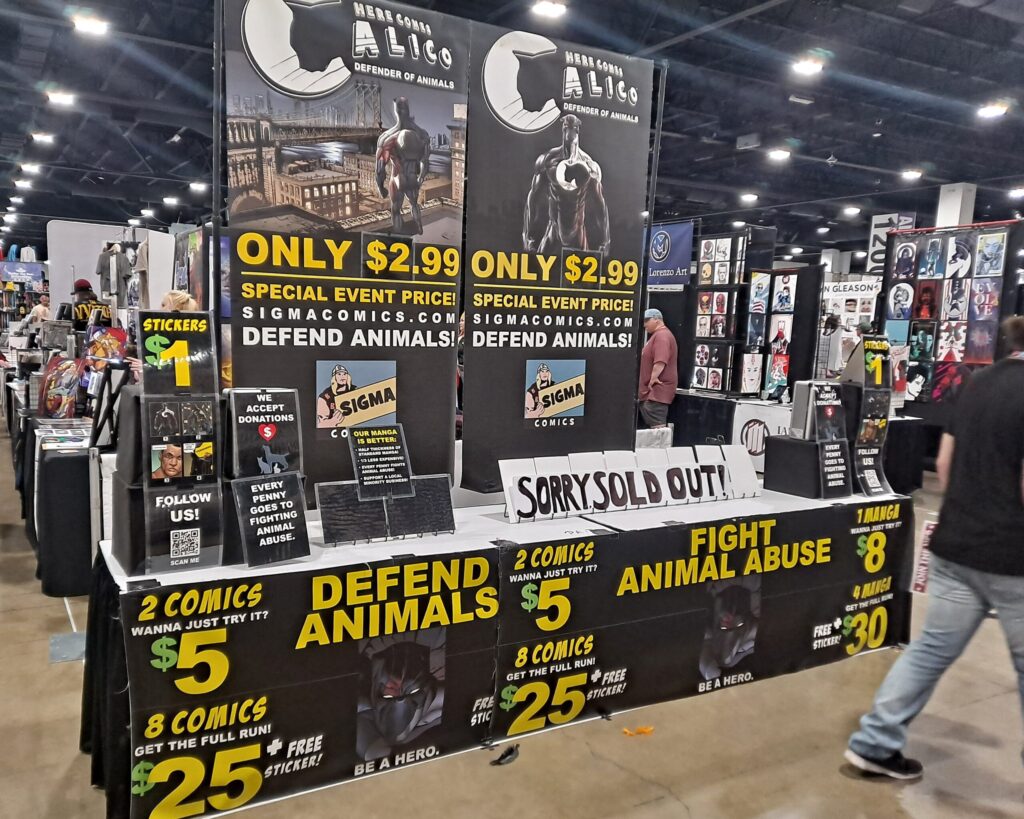
Sigma Comics uses strong black-and-yellow branding because those colors create heavy visual contrast. The goal is to stand out inside a convention hall instead of disappearing into everything around it.
That made me look at convention booths differently. Before a person reads your comic, they have already seen your brand. That means the booth itself is an advertisement.
Why a SOLD OUT Sign Is Actually Great Marketing
This might be one of my favorite ideas from the entire discussion.
When Sigma Comics sells through its convention inventory, it uses a large SOLD OUT banner. At first you might think, “Fatal Jay, if you’re sold out, how can that help you sell anything?”
Because everybody walking past that booth sees those words.
Now they start wondering what they missed. Why did everybody buy this comic? Who is Calico? Why did this independent book sell out when other people still have books stacked everywhere?
That creates curiosity and social proof.
The smart part is making sure the relationship doesn’t end there. A QR code can send those people to your website, email signup, social accounts, or online store. Even when the physical books are gone, the booth can still create future customers.
Your Email List Might Be More Valuable Than You Think
Social media is powerful, but you don’t control social media.
You can have thousands of followers and still have an algorithm show your next post to only a small percentage of them. YouTube, Facebook, Instagram, X, TikTok, and every other platform control how much access you have to the audience you’ve built.
An email list gives you another direct connection.
When somebody visits your booth, buys your comic, or visits your website, give them a reason to join that list. When Issue #2 drops, send an email. When you launch a new Kickstarter, send an email. When you’re appearing at a convention, send an email.
Instead of starting from zero every time you release something, you now have people who already know your brand.
That’s how somebody who bought Issue #1 can eventually become the person who owns Issue #14.
Use Kickstarter for More Than Raising Money
Kickstarter is obviously useful for funding comics, but I think indie creators should look at it as a discovery and marketing platform too.
Somebody browsing Kickstarter may have absolutely no idea who you are. Then they see the artwork, click the campaign, discover your character, and suddenly you have a potential new reader.
That means even when crowdfunding isn’t your biggest source of income, it can still become another arm of your business. Kickstarter leads to your website. Your website leads to the email list. Your email list leads back to the next release.
You want all these different parts of your indie comic business working together.
Stop Sleeping on Local Businesses

This may be one of the most underrated indie comic strategies out there.
Creators spend so much time worrying about getting into major comic shops that they sometimes ignore businesses right down the street. What about local bookstores, coffee shops, barbershops, record stores, tattoo shops, corner stores, collectible stores, or restaurants?
Walk inside and ask.
The worst thing they can tell you is no.
Independent businesses may actually be more willing to work with another independent business because both sides understand the grind. If you can explain how displaying your comic might benefit their customers and create attention for their store, you might be surprised by how many people are willing to try something.
You don’t have to wait for Marvel’s distribution system to give you permission. You’re independent. Use that independence.
The Calico Pizza Box Strategy Is Crazy—in a Good Way
One of the wildest marketing ideas I heard involved pizza boxes.
Sigma Comics created Here Comes Calico pizza boxes and distributed them through New York pizza shops. The boxes contained the character branding and information directing people toward the comic and website.
Now think about what happened there. Somebody who may never have attended a comic convention, visited a comic shop, watched a comic-book YouTube channel, or searched for indie comics could order dinner and suddenly have Calico sitting on their kitchen table.
That’s creative marketing.
Will every crazy promotional idea work? No. That’s not the point. The point is testing different ideas instead of automatically rejecting them because they’re unusual.
Try A. Try B. Try C. Try D. Find out what actually gets people’s attention and brings them into your universe.
Build the Character Before Trying to Build the Universe
This is something I think a lot of creators desperately need to hear.
Everybody wants a cinematic universe now. You create Issue #1 and you’re already talking about five spin-offs, three crossovers, an animated movie, action figures, and the big team-up.
Slow down, bro.
Does anybody care about Character #1 yet?
Before worrying about a giant universe, make sure your main character has a strong foundation. What does this person want? What do they fear? What makes them different? What happens when they’re under pressure? Who surrounds them? What does their world feel like?
One of the strongest ideas discussed in my interview was that once a character has a solid foundation, the character almost begins telling the writer what he or she would do. The creator stops forcing situations onto the character and instead understands how that character naturally reacts.
I compared that to the biblical idea of building your house on rock instead of sand. Build the foundation first. Then start putting floors on the house.
Your Real Experiences Can Make Your Indie Comic Unique
Self-inserts get a bad reputation in comic books, and sometimes that criticism is deserved. If you take Batman, Superman, or Spider-Man and completely transform that established character into yourself, fans are naturally going to push back.
But your own original character is different.
If you created the character, use your life.
Use your neighborhood. Use your culture. Use your victories. Use the mistakes you made. Use what scared you. Use your sense of humor. Use experiences that somebody sitting on the other side of the country could never duplicate.
Calico grew out of real experiences involving New York City, fighting, street culture, a love for animals, and decades of comic-book influences.
That gives an original character something extremely valuable: authenticity.
Another creator can copy your costume colors. They can imitate your art style. They can even borrow elements of your plot. They cannot copy the life that produced your point of view.
Find Mentors Who Know More Than You
This is one of the smartest things any creator can do.
When you’ve been staring at your own work for months, you become too close to it. Everything starts making sense because you already know what you meant. You need somebody experienced enough to look at the work and tell you when something isn’t hitting.
Double H talked about receiving guidance from established comic creators such as Klaus Janson, Mike Baron, Jim Steranko, and others during the development of Calico. That outside guidance helped him think differently about character development, storytelling, and the hero’s journey.
That isn’t weakness. That’s how you improve.
The best fighters have trainers. The best athletes have coaches. Writers and artists should not think they’re somehow above getting advice.
Find somebody who knows more than you. Listen to them. Learn what works. Then put your own flavor on it.
Story Matters More Than Expensive Paper
Indie creators can easily fall into the trap of believing everything has to look extremely premium.
Premium paper. Premium cover. Premium packaging. Premium everything.
Suddenly you have a $15 or $20 comic that nobody has heard of.
Sigma Comics takes a different approach by using an old-school newsprint-style format to help control the cost of producing large quantities of books.
That raises an important question: When you remember your favorite comic book from childhood, do you remember the paper stock or do you remember the story?
Look at something like The Walking Dead. The early books weren’t succeeding because readers were obsessed with expensive glossy paper. People came back because they cared about what happened next.
Beautiful production is great, but premium paper cannot save a boring character.
Think Beyond the Comic Book
The way people consume entertainment has changed.
A person might discover a story through an anime, then buy the manga. Somebody else might see a movie and then read the original comic. Another person might listen to an audiobook because they don’t have time to sit down with a novel.
One property can now exist across several forms of entertainment.
That’s why the long-term vision discussed for Calico includes animation. An animated adaptation could introduce the character to an audience that may never walk inside a comic-book shop.
Look at how powerful anime has become as a marketing vehicle for manga. A show catches fire on streaming, and suddenly millions of people want to read the original books.
Independent comic creators should understand that opportunity. Your comic may be the foundation of the IP without being the only way audiences experience it.
But once again, don’t skip steps. Make the comic fire first.
The Real Secret to Dominating the Indie Comic Market
After breaking down all these different strategies, the real secret is actually simple.
You cannot half-step.
If creating comics is your hobby, there is absolutely nothing wrong with that. Make the books, enjoy yourself, and create something you’re proud of.
But if you tell me, “Fatal Jay, I want this indie comic to become a successful business,” then you have to treat it like a business.
That means going to conventions, talking with customers, building an email list, improving your website, testing Kickstarter campaigns, developing relationships with stores, experimenting with marketing ideas, working on your booth presentation, studying pricing, asking readers what they think, learning from experienced creators, and improving every new release.
There isn’t one magical website that will make you successful.
The secret is the grind combined with a strategy.
Final Thoughts: Don’t Just Create a Comic—Build a Brand
The indie comic market doesn’t need more talented creators sitting around waiting to be discovered.
Go find your audience.
Your comic book is the art, but once you decide to sell it, you are also running a business. That means understanding marketing, building customer relationships, testing ideas, learning from failures, and constantly finding better ways to put your work in front of people.
What impressed me most about this conversation was not one specific advertising trick. It was the mentality behind everything: believe in your product enough to get outside your comfort zone and fight for it.
That’s the untold secret to dominating the indie comic market.
Build the character. Build the story. Build the brand. Build the audience. And get your boots on the ground.
Indie Comic Marketing FAQ
What is the best way to sell indie comics?
There is no single best method. A strong strategy combines direct convention sales, an online store, email marketing, crowdfunding, comic shops, social media, local businesses, and other ways of reaching readers. Diversifying where customers can find you makes the business less dependent on one platform.
Are comic conventions worth it for indie creators?
Comic conventions can be extremely valuable because creators can speak directly with potential readers, explain their characters, gather customer feedback, build an email list, and make direct sales. A convention also lets creators learn which pitches, prices, artwork, and products get the strongest reactions.
How can I market an indie comic without a large budget?
Start with direct relationships. Use social media, email marketing, QR codes, your website, smaller conventions, local businesses, podcasts, YouTube channels, and partnerships with other independent creators. Test inexpensive ideas first and put more money behind the strategies that actually produce results.
Should indie comic creators use Kickstarter?
Kickstarter can help creators finance production while also introducing their comics to new readers. It works best as one part of a larger strategy rather than the creator’s only way of reaching customers.
Should I sell my independent comic through comic shops?
Yes, but comic shops do not have to be your only sales channel. Selling directly through conventions and your website can allow you to personally introduce readers to your characters while comic shops provide another place for customers to discover the books.
What makes an indie comic successful?
The foundation is a compelling character and story. From there, success requires consistency, good presentation, smart pricing, branding, marketing, reader relationships, and a willingness to experiment until you find what works.